Forgotify: What It Is, How It Works, and Why 4 Million Songs Still Unheard on Spotify
Forgotify is a free web app at forgotify.com that plays Spotify songs with zero streams. It pulls tracks with a 0 popularity rating from Spotify’s API (Application Programming Interface) and delivers them one at a time. Once you play a song, its play count rises to 1 — and it disappears from Forgotify forever. You may be the first and only person ever to hear it on Spotify.
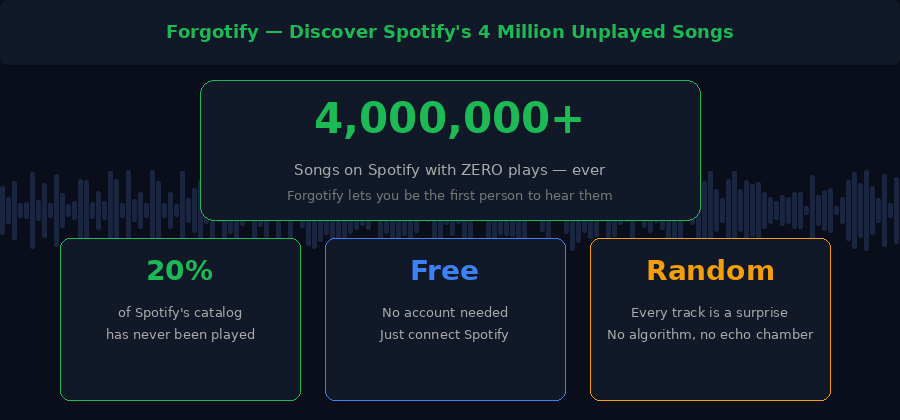
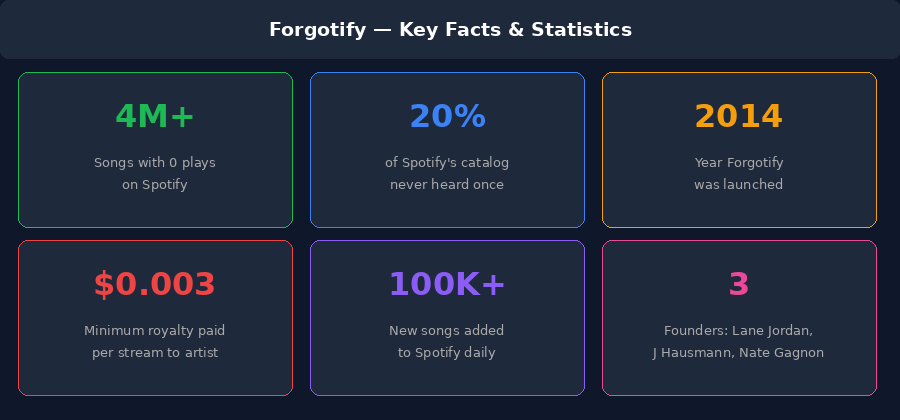
The idea came from a striking fact: over 20% of Spotify’s catalog — more than 4 million songs — has never been played. Not once. Not even by the artists who uploaded them. Lane Jordan discovered this in late 2013, built Forgotify with J Hausmann and Nate Gagnon, and launched it in January 2014. The site has been running ever since.
What Is Forgotify?
Forgotify is a music discovery tool built on top of Spotify’s API. It doesn’t store any music — it accesses Spotify’s own catalog and filters for tracks with a popularity score of exactly 0. That score indicates the track has never been selected by a user, not even once.
The site was built by 3 people who work in advertising: Lane Jordan (interactive art director), J Hausmann (developer), and Nate Gagnon (copywriter). All 3 are based in San Francisco, California. Forgotify is not affiliated with Spotify — it is an independent third-party service.
Forgotify’s core mechanic is simple and intentionally irreversible: play a song, give it its first stream, and it exits the Forgotify database permanently. The track has been heard. Its mission is complete.
The Problem Forgotify Solves: Why Millions of Songs Have 0 Plays
Spotify hosts over 100 million tracks. Of that total, approximately 20% have never been heard — not even partially. The number reaches over 4 million songs when filtered for full zero-play tracks.
3 main reasons explain why so many songs stay unheard:
- Upload volume — over 100,000 new tracks are added to Spotify every day. Most get buried immediately
- Algorithm bias — Spotify’s recommendation engine favors already-popular songs, keeping new or obscure music invisible
- No discovery path — without being in a playlist, chart, or algorithm recommendation, a song has no route to listeners
The result is a massive catalog of music from real artists — classical recordings, folk songs, experimental tracks, recordings from the 1930s through today — that sits in Spotify’s database completely unheard. Forgotify exists specifically to fix that.
How Forgotify Works: The Technical Side
Forgotify crawls Spotify’s API daily and queries tracks with a popularity rating of 0. Spotify assigns each track a popularity score between 0 and 100 based on stream count. A score of 0 means zero plays.
The Forgotify database refreshes every day. Any track that received even 1 play is removed from the database — it no longer qualifies. New zero-play tracks added to Spotify get added to Forgotify’s pool over time, which is why the site never runs out of songs despite millions of plays through the site.
The playback happens through an embedded Spotify player. Users need an active Spotify account to hear full tracks. Without an account, only 30-second previews may play depending on the Spotify API tier available.
Forgotify also mixes eras and genres intentionally — the algorithm avoids giving 3 consecutive songs from the same decade or genre. Each session covers wildly different musical territory: a 1940s big-band track, then bhangra, then 2007 soft rock, then a New Guinea chant.
How to Use Forgotify: Step-by-Step
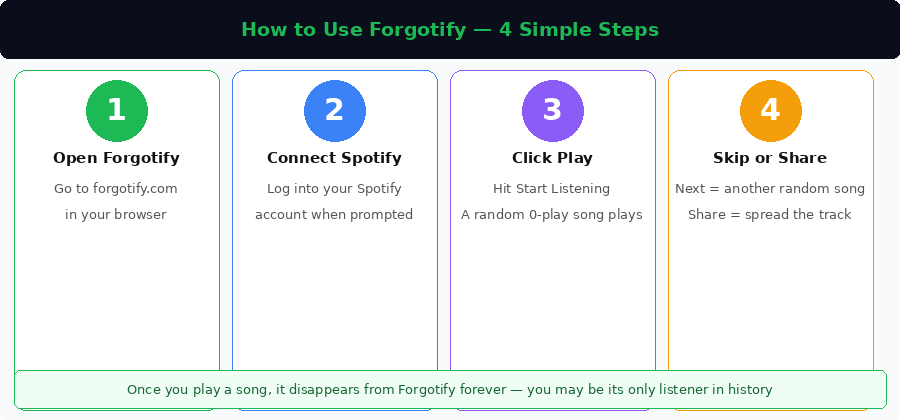
Step 1: Open forgotify.com
Go to forgotify.com in any browser on desktop or mobile. No app download needed. The site runs entirely in-browser.
Step 2: Connect Your Spotify Account
Click Start Listening. Forgotify will prompt you to log into Spotify. Use your existing Spotify account — free or premium both work. Forgotify does not store your Spotify credentials.
Step 3: Hit Play and Listen
A random song with 0 plays appears with its album cover. Click the play button. The track plays through Spotify’s embedded player. You are now, in all likelihood, the first person to stream this song on Spotify. Each play sends a micro-royalty of roughly $0.003 to $0.005 to the artist.
Step 4: Skip, Share, or Save
- Next — skip to another unplayed song instantly
- Share — post the track to social media so others can discover it
- Star or playlist — add it to a Spotify playlist directly from the player if you want to keep it
Once you hit play, that specific track exits Forgotify. Your session is the only Forgotify session it will ever appear in.
Forgotify vs Spotify’s Own Discovery Features
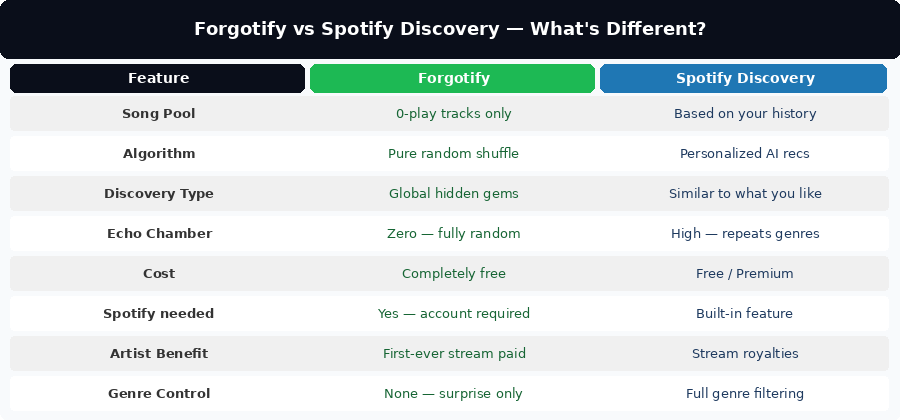
| Feature | Forgotify | Spotify Discovery |
| Song Pool | 0-play tracks only | Based on listening history |
| Algorithm | Pure random shuffle | Personalized AI recommendations |
| Discovery Type | Global hidden gems — any genre/era | Similar to what you already like |
| Echo Chamber | Zero — fully random every time | High — reinforces existing taste |
| Cost | Completely free | Free tier / Premium subscription |
| Spotify Account | Required to hear full tracks | Built-in — no separate login |
| Artist Benefit | First-ever stream paid to artist | Stream royalties on popular tracks |
| Genre / Mood Control | None — surprise only | Full genre and mood filtering |
| Platform | Web browser only | Web, iOS, Android, desktop app |
The History of Forgotify
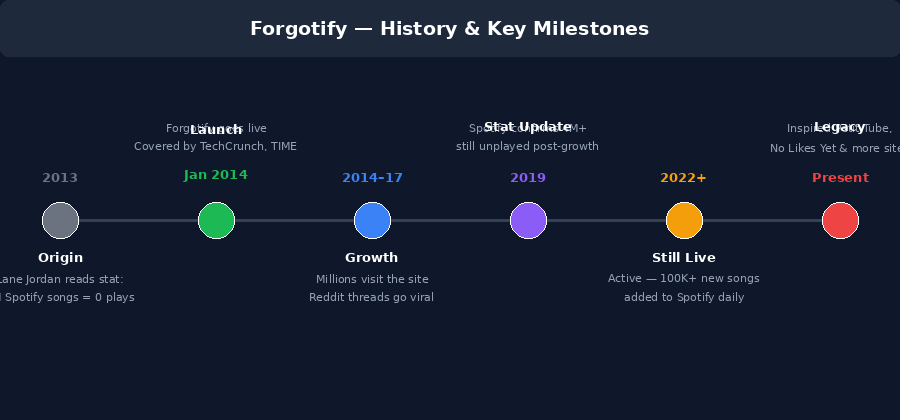
The Origin: 2013
Lane Jordan read a statistic in late 2013: 20% of Spotify’s catalog had never been played. Spotify had roughly 20 million tracks at the time, meaning 4 million songs sat in complete silence. Jordan called it ‘a musical travesty’ and decided to do something about it.
The Build
Jordan brought in J Hausmann to handle the backend development. Nate Gagnon handled copy and design work. The 3 spent a few weeks building the site — J worked on the Spotify API integration and database, while Lane and Nate handled the front-end design and writing. All 3 had day jobs in the advertising industry at the time.
Official Launch: January 2014
Forgotify launched officially on January 30, 2014. TechCrunch, TIME magazine, Digital Trends, and HuffPost all covered the launch within 24 hours. The site went viral immediately, with thousands of users joining on day one.
Viral Growth: 2014–2017
Reddit threads repeatedly surfaced Forgotify to new audiences between 2014 and 2017. The site needed no marketing — the concept was compelling enough that word spread organically. Co-founder Nate Gagnon noted that 200,000 people listening for an average of 1 hour could theoretically exhaust the database — but new songs kept getting added to Spotify faster than Forgotify could play them.
The Stat Update: 2019
Spotify released new data confirming that over 4 million songs still had zero plays as of October 2019 — 5 years after Forgotify launched. Despite millions of sessions on the site, the pool of unheard songs had not shrunk. New music was being uploaded faster than Forgotify could play it.
Present Day
Forgotify continues to operate. By 2023, over 100,000 new songs were being added to Spotify daily — the majority of which would never receive a single play. The pool of zero-play tracks has grown larger than when Forgotify launched, not smaller. Forgotify has inspired similar sites: Petit Tube (YouTube videos with 0 views) and No Likes Yet (Instagram posts with 0 likes).
Forgotify Version History and Updates
Forgotify has maintained the same core function since launch: find zero-play Spotify tracks and play them randomly. The major changes over its history:
| Version / Period | Changes |
| January 2014 — Initial launch | Basic random player using Spotify embedded widget. Spotify API integration for 0-popularity track filtering |
| 2014 — Post-launch | Database refresh system added — runs daily to remove played tracks and add newly zero-play tracks |
| 2015–2017 | Social sharing features improved. Facebook and Twitter share buttons added to spread individual track discoveries |
| 2018–2020 | Stability updates following Spotify API changes. Spotify periodically updates API access rules requiring Forgotify to adapt |
| 2021–2023 | Continued operation. Mobile browser compatibility improved. Spotify’s API changes affected some functionality intermittently |
| Present | Site operates at forgotify.com. Requires active Spotify account for full-track playback. Database refreshes daily |
Forgotify does not release version numbers publicly — all updates are server-side and invisible to users. The site’s simplicity means there is no downloadable app and no version archive. All access is through the browser at forgotify.com.
Who Should Use Forgotify?
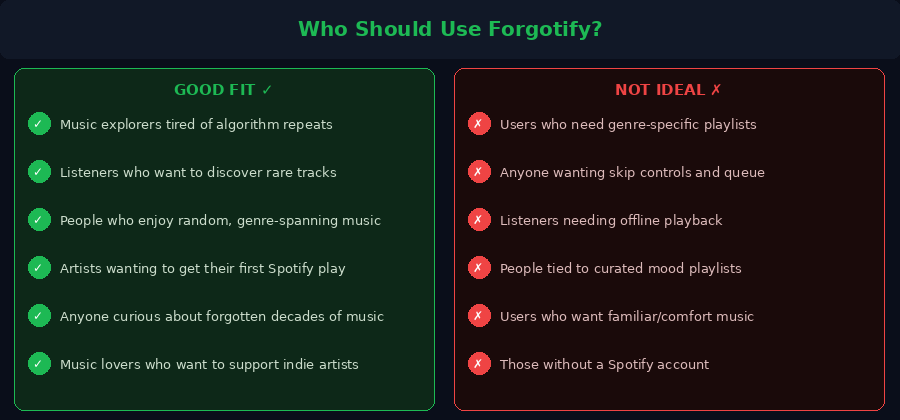
Forgotify Works Best For These 5 Users
- Music explorers who feel stuck in Spotify’s algorithm repeat cycle
- Listeners curious about obscure genres — 1930s jazz, Bollywood, folk recordings from the 1970s, experimental classical
- People who want to discover indie artists before anyone else and give them their first stream
- Users who enjoy the thrill of pure randomness — not knowing what genre, language, or decade comes next
- Artists with unreleased or zero-play tracks who want to submit their music for discovery
Forgotify Is Not Ideal For These 4 Users
- Listeners who need genre filtering or mood-based playlists
- Users who want skip controls and full queue management
- Anyone without a Spotify account — partial playback only without login
- People looking for familiar, comfort-based music rather than genuine surprises
Forgotify Alternatives: 5 Similar Tools
Forgotify is unique in targeting strictly zero-play tracks, but 5 alternatives help discover less-heard music:
| Tool | What It Does | Best For |
| TapeFear | Discovers Spotify hidden gems that algorithms never surface | Spotify users wanting non-algorithmic picks |
| Petit Tube | YouTube equivalent of Forgotify — videos with 0 or near-0 views | Video content discovery |
| No Likes Yet | Instagram posts with 0 likes — same concept applied to photos | Visual content discovery |
| Bandcamp | Direct-to-fan platform for independent artists — often zero-stream new releases | Supporting indie artists directly |
| Last.fm | Tracks listening history and recommends based on taste profiles — not zero-play focused | Personalized underground music recs |
| r/listentothis | Reddit community sharing lesser-known artists and tracks | Community-curated music discovery |
Why So Many Songs Stay Unheard: 5 Root Causes
- Upload volume — Spotify adds 100,000+ new songs daily. Most are immediately invisible
- No marketing budget — independent artists who upload without promotion receive zero organic discovery
- Algorithm exclusion — Spotify’s recommendation engine requires prior listening data to place a song; a zero-play track has none
- Catalog age — recordings from the 1930s, 40s, and 50s were uploaded to Spotify years ago but attract few listeners from younger demographics
- Niche genres — highly specific music such as regional folk recordings, language-specific pop, or experimental compositions often fails to find its audience on a global platform
What Happens When You Play a Song on Forgotify?
3 things happen the moment you play a song on Forgotify:
- The artist receives a Spotify streaming royalty — roughly $0.003 to $0.005 per stream. Small, but it is the artist’s first payment ever for that track
- The song’s play count on Spotify changes from 0 to 1 — it exits Forgotify’s database and never appears on the site again
- You become the first person in Spotify’s history to stream that specific track — unless someone found it directly on Spotify first
Unless the song goes viral after your play — which has happened in rare cases — you may remain the only person who has ever streamed it through Spotify.
Frequently Asked Questions
Final Take: Why Forgotify Still Matters
Forgotify solves a real problem: music gets lost at scale. Spotify’s algorithm is built to maximize engagement, not discovery. A song with zero plays has no data for the algorithm to work with — so it stays invisible indefinitely. Forgotify breaks that loop with a direct bypass.
The site has no monetization, no ads, and no agenda beyond giving forgotten music a chance to be heard. A single play through Forgotify is all a track needs to exit the zero-play category and enter Spotify’s standard recommendation pool.
For listeners, it is a genuine discovery experience — unpredictable, wide-ranging, and occasionally remarkable. For artists, it is a second chance at a first impression. For the internet, it is one of the few tools built to help the overlooked rather than amplify the already popular.